Under Black Waters, Clocks Run Slowly
june 18 - june 22, 2025
Hartslane. New Cross Gate, London
ARTISTS: Lulú Lobo, Gonzalo Maggi, Julieta Barderi, Bernabé Arévalo y Felipe Pineda.
Curated by: Leo Babsky
Intemperie, alongside Leo Babsky, present the group show: Under Black Waters, Clocks Run Slowly.
ABOUT THE EXHIBITION
‘Under Black Waters, Clocks Run Slowly’, inhabits a suspended space where memory, language and perception become fluid. The artworks presented here navigate territory where time is no longer linear, instead, it pools, fractures and slows to an unmeasurable rhythm.
Taking it’s title from two distant but resonant sources: a chapter in Argentinian writer Mariana Enriquez’s ‘Things We Lost in the Fire’, and a fundamental principle of Einstein’s theory of relativity— ‘moving clocks run slowly.’ Together, these references evoke submerged realities, quiet distortions, and temporal drift.
This collaboration between Buenos Aires-based Intemperie Gallery and English curator Leo Babsky brings together four Argentinian and one Chilean artist, whose practices—spanning painting, sculpture, installation, and photography— draw from the tension between the visible and the obscured. History, architecture, time and language become intertwined forces, revealing narratives that drift between past and present, between forgetting and remembering.


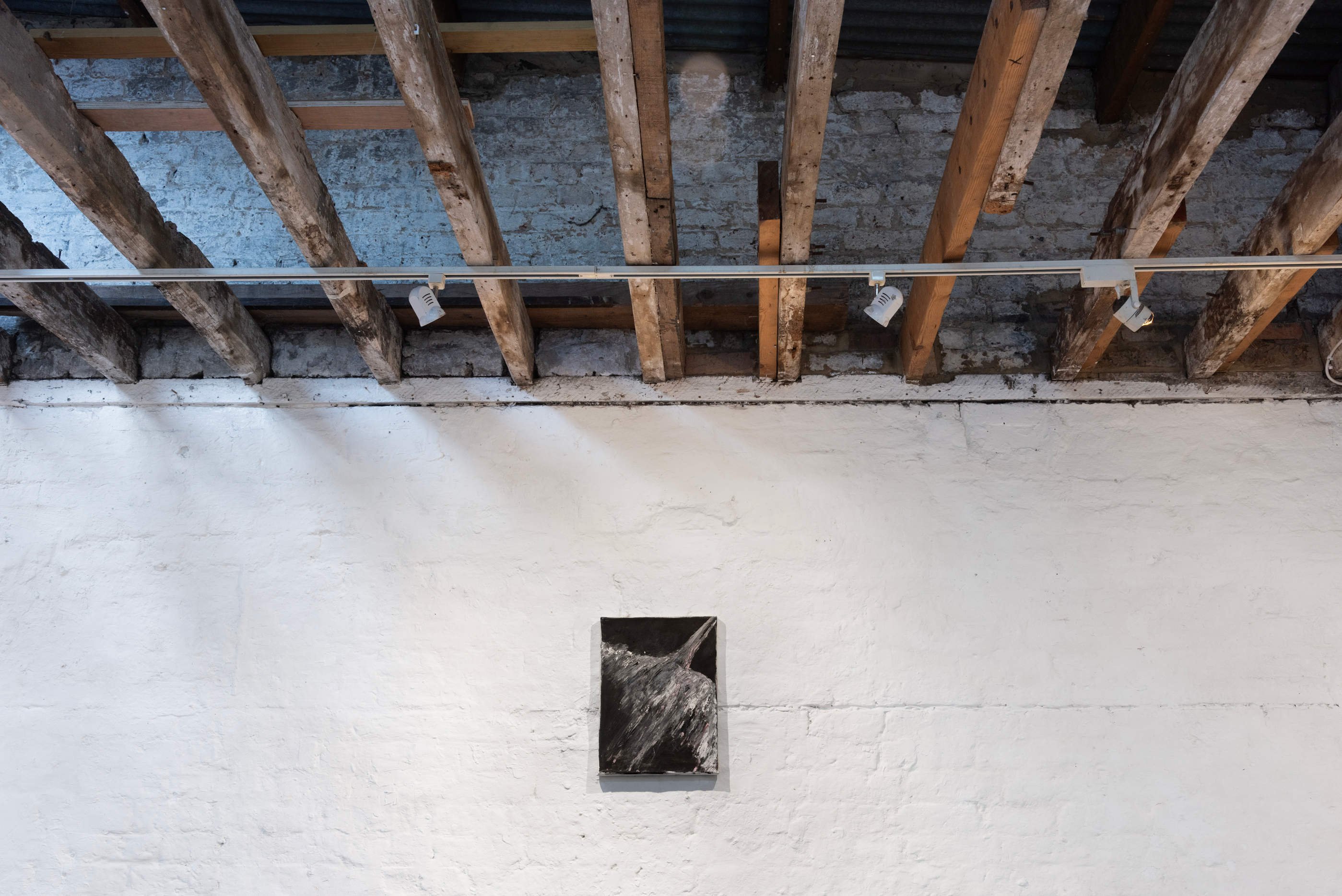


Rooted in the spiritual and political traditions of Afro-Indigenous cultures in the Americas, Bernabé Arevalo’s (ARG) work investigates rebirth and migration as portals into contemporary expressions of Blackness and identity in Argentina.
Haunting the exhibition, his dense and kinetic paintings of bird analogues swoop across the space; this hybrid representation of the sacred bird from various Indigenous cultures, and its connection to territory and migration make flight both escape and return — a cyclical rhythm echoing the show’s central themes of suspended temporality and metamodernity.
Felipe Pineda (CHL) seeks to understand how we affect one another in interpersonal relationships, addressing themes such as intersubjectivity, miscommunication, language, displacement and geographical distance, and the ways these aspects shape our social and personal realities.
Shown here, ‘To hello and goodbye’, captures the ache and dissonance of cultural dislocation; reflecting on body language as a tool for communication when speaking is not possible or when one does not understand a language. Inspired by the artists experience as a student in a foreign land, communicating in another language within a context not fully understood, these sculptures depict ambiguous situations of para-verbal communication between two people, exploring the dimensions of action and distance. At the same time, the sculptures explore the notion of touch; designed to be touched, yet, due to their condition as sculptures, they cannot be touched—a wry comment on failures of understanding and contradictory signals.
Erase and cover, two gestures inherent to painting that allow Julieta Barderi (ARG) to develop an image built through the accumulation of layers.
Shown here, Barderi’s monumental painting, Una expedición animista en un mundo inactivo (An animist expedition in a dormant world), depicts a barren landscape haunted by ruins and remnants of human civilisation - perhaps now long gone.
Echoing Felipe Pineda’s isolated appendages, Barderi’s works are also littered with fragmented sections of the body, evoking the ex-voto - a votive offering to a saint or deity as a token of gratitude, often a painted or modelled reproduction of a miraculously healed body part - thus imbuing the works with a quasi-religious reverence.
Lulú Lobo (ARG) also traces language through gesture, repetition, and absence. Her works—delicate, fragmented, and quietly resisting categorisation—hover between ornament and structure, between drawing and disappearance.
Lobo’s practice is a back-and-forth of imprints and gestures; traces and fragments flutter through her gentle works, evoking a world shaped not by what is said, but by what resists articulation.
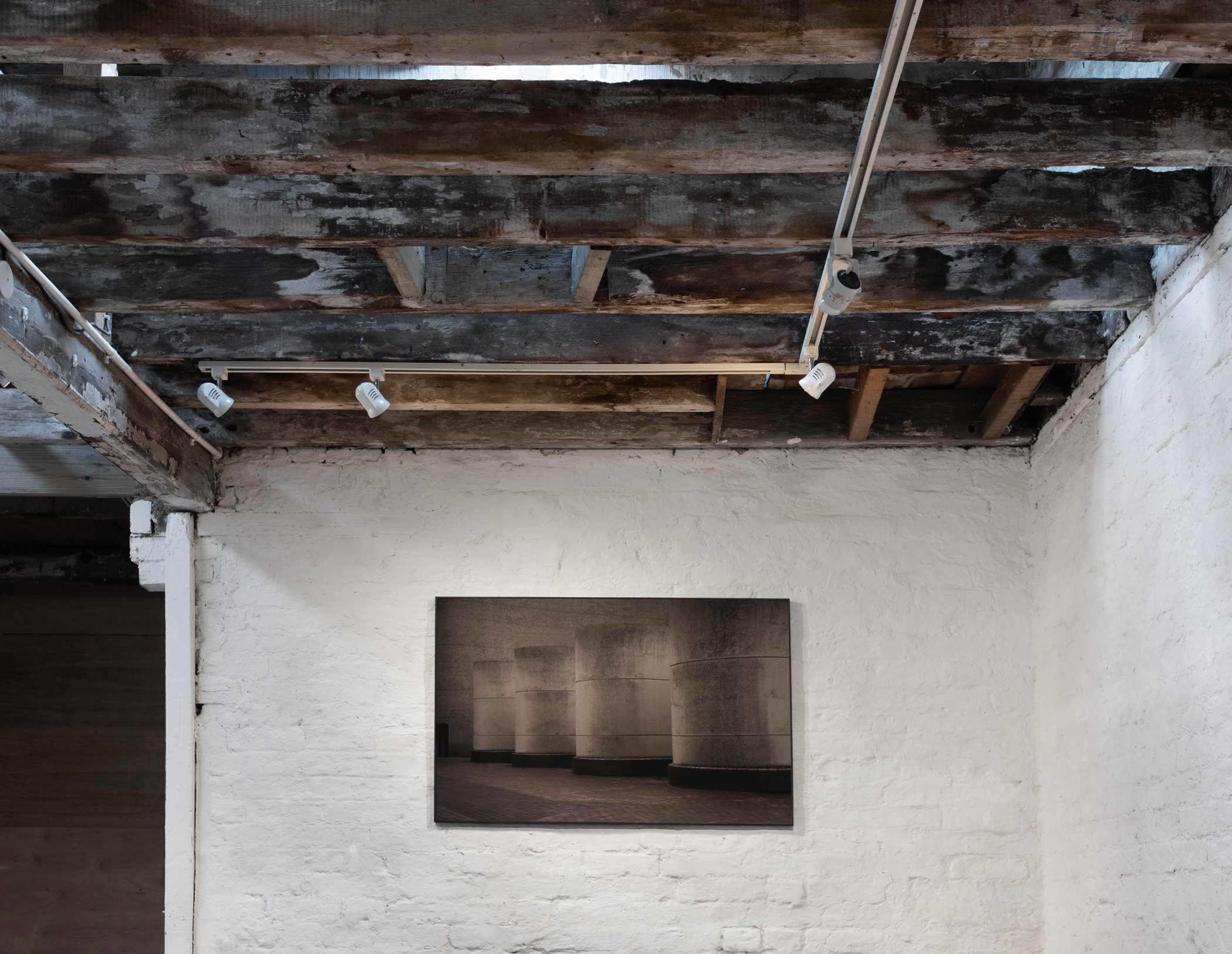
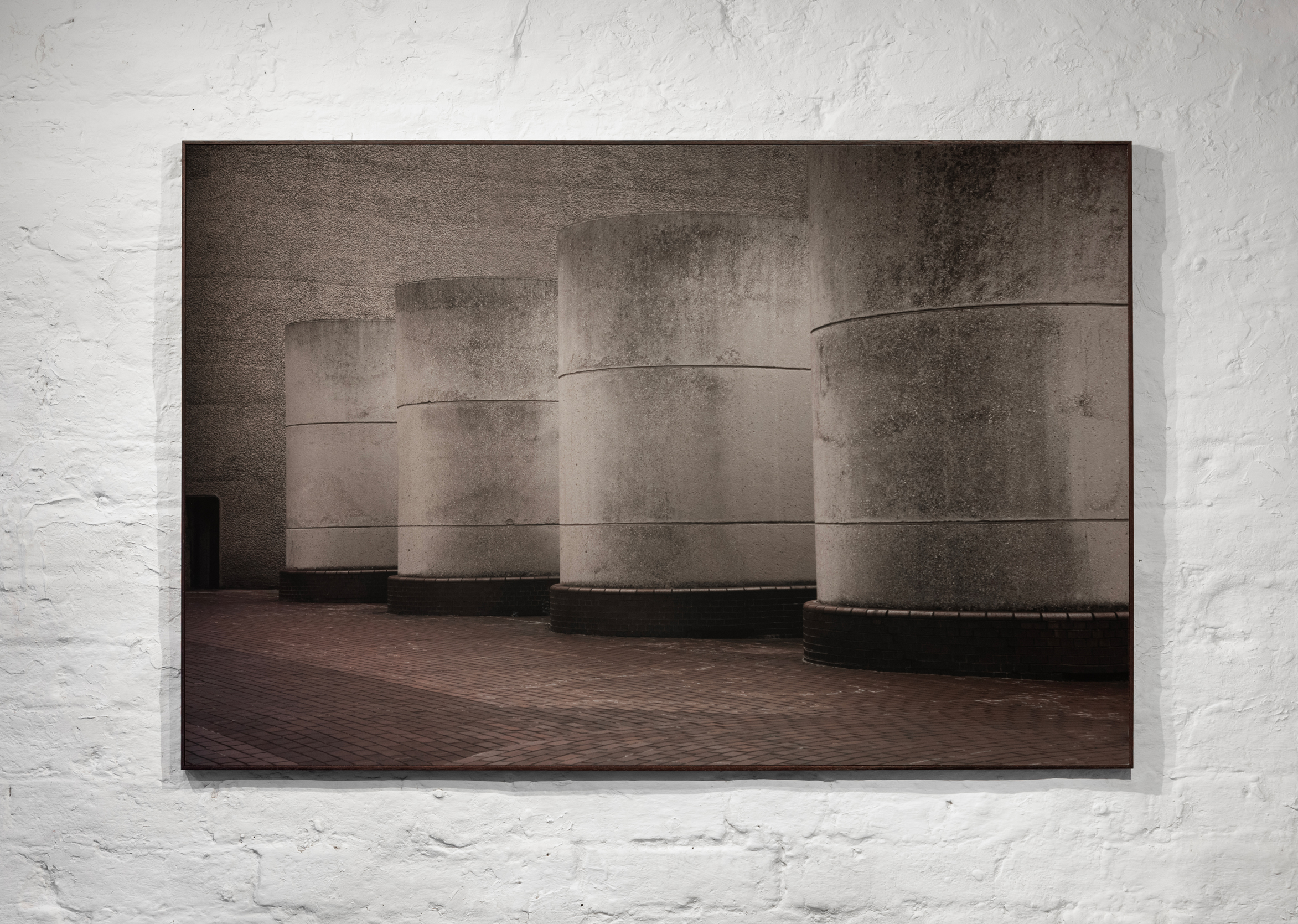
Gonzalo Maggi (ARG) situates his photographs in a liminal zone between fiction and document, portrait and landscape. Carefully staged yet emotionally distant, his images evoke a frozen moment—the calm before or after something unnamed. Lit with the flat metallic greys of overcast light, they suggest a world paused, holding its breath.Time here is not frozen in clarity but dulled, as if under thick glass or water—distorted, lethargic, and spectral.
Together, these five artists conjure a shared terrain where histories are half-sunk, gestures ripple across time, and the surface never quite settles. Under Black Waters, Clocks Run Slowly is not about clarity but about attending to the murky, the fragmented, and the ephemeral.